Vitakri Field Force in Afghanistan, 1879
A new postal history item discovered

The Second Anglo-Afghan War of 1878-81 was yet another of the innumerable ‘little wars’ fought in Queen Victoria’s name.1 In his 1973 book, Queen Victoria’s Little Wars, Byron Farwell writes:
There was not a single year in Queen Victoria's long reign in which somewhere in the world her soldiers were not fighting for her and for her empire. From 1837 until 1901, in Asia, Africa, Arabia and elsewhere, British troops were engaged in almost constant combat. It was the price of empire, of world, leadership, and of national pride – and it was paid, usually without regrets or very much thought.2
…
By 1879, Britain was engaged in two serious little wars at the same time: one in Zululand…and the other in Afghanistan.3
The Second Anglo-Afghan War
The war in Afghanistan was fought as part of the ‘Great Game’ – the 19th century geopolitical rivalry between Britain and Russia for dominance and supremacy in Central Asia (Figure 1). Trouble started because the British feared that if they did not influence Afghan policies, Russia would. So, in November 1878, Afghanistan was invaded from India through three different routes.
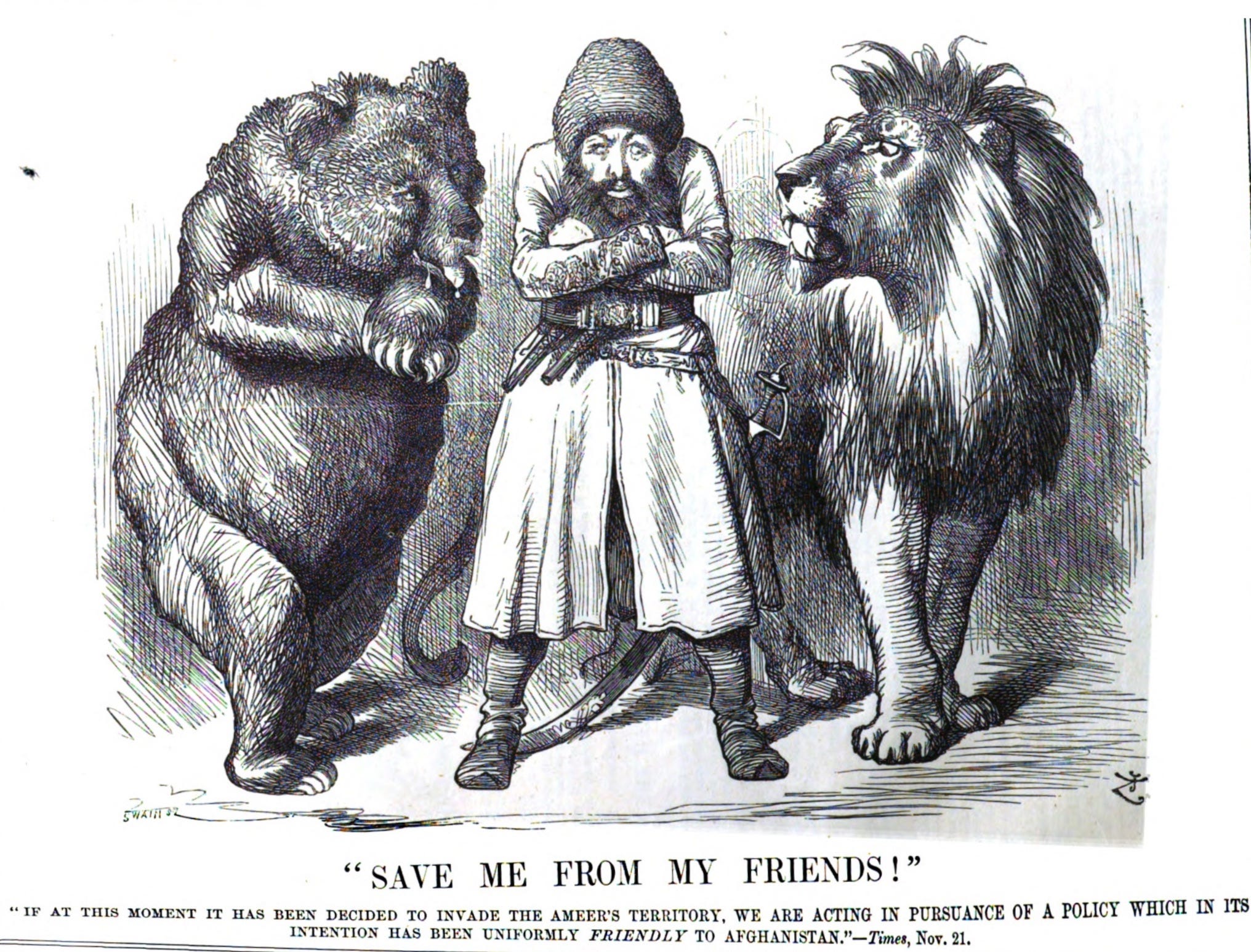
The ‘First Phase’ of the war began on 21 November 1878 and ended when the Treaty of Gandamak was signed on 26 May 1879. The Afghans were forced to accept a British resident in Kabul and consent to British control of Afghanistan’s foreign policy.
The main forces involved in this phase of the war were:
Peshawar Valley Field Force
Kurrum Field Force
Kandahar Field Force
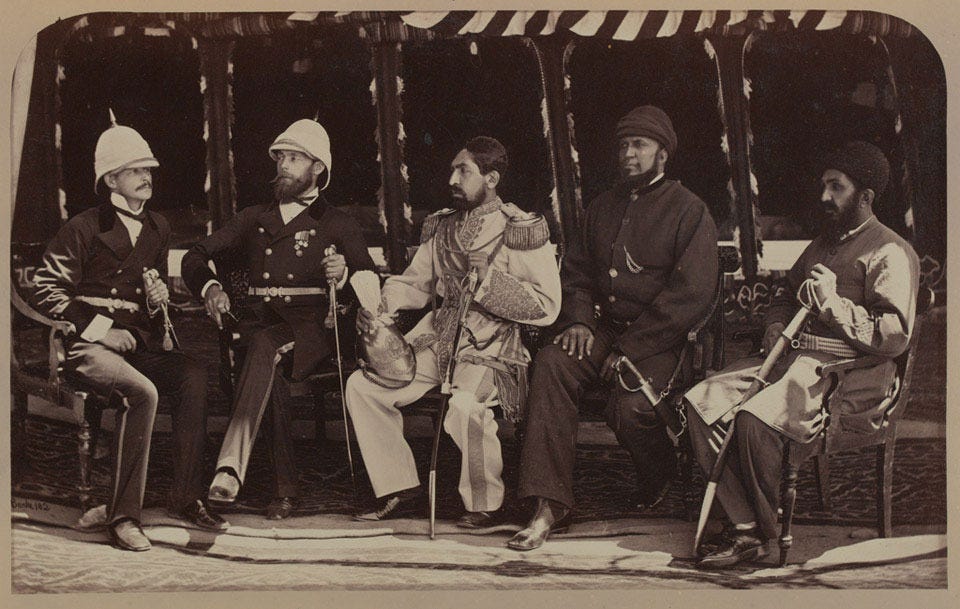
The ‘Second Phase’ commenced upon the killing of the British Resident, Major Sir Pierre Louis Napoleon Cavagnari (1841-1879) (Figure 2) on 3 September 1879 in a general uprising in Kabul.
The main forces involved over the coming months were:
Kabul Field Force, which later became the 1st and 2nd divisions of the North Afghanistan Field Force, and still later the Kabul-Kandahar Field Force
Ghazni Field Force, later renamed as the 3rd division of the North Afghanistan Field Force
Khyber Line Force
Kandahar Field Force
It is not the intention of this article to go into the details of these various field forces.
Vitakri Field Force
A lesser-known force deployed during the war was the Vitakri Field Force. The intent of this was to establish a permanent cantonment to control the passes between India and Pishin in South Afghanistan (Figure 3).
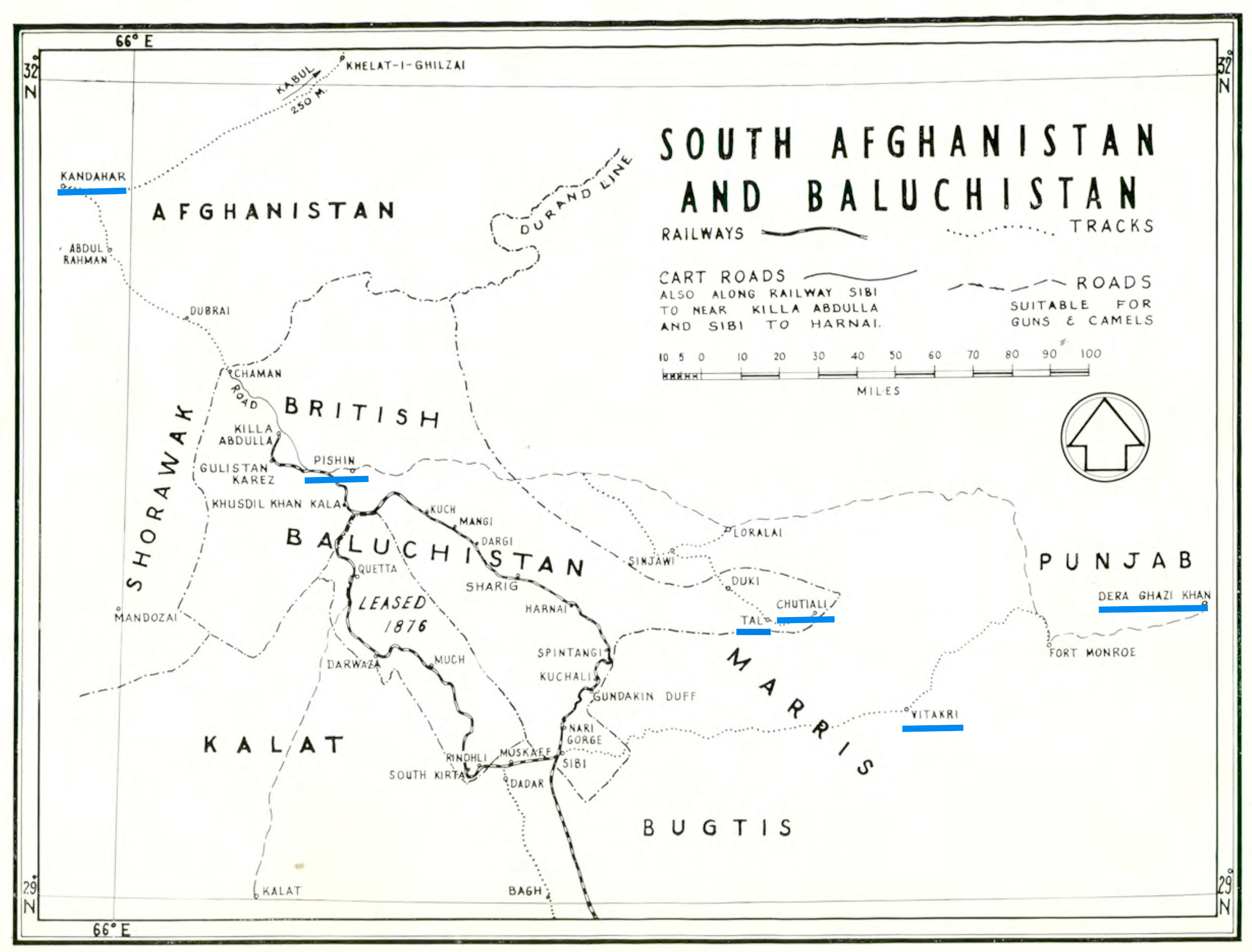
In early 1879, anticipating that matters would be imminently settled and before the advent of the hot weather, it was decided to reduce the forces in South Afghanistan. Major-General Michael Biddulph, commanding the 2nd Division of the Kandahar Field Force, was ordered to march back to India from Kandahar via Pishin Valley and the new unexplored route of Thal-Chotiali (or Tal-Chutiali).
Meanwhile, on 23 February 1879, a force consisting of the 15th Bengal Cavalry (Lancers), 21st Madras Infantry, and 30th Madras Infantry left Dera Ghazi Khan in British India. It was destined to march into Baluchistan to act as a support to General Biddulph’s forces marching eastwards.
This force was commanded by Colonel (later Major-General) Guy Annesley Prendergast (1834–1919) of the 15th Bengal Native Cavalry. They were designated as the Dera Ghazi Column of the Thal-Chotiali Field Force.
The Dera Ghazi Khan column reached Vitakri on 6 March and then moved forward to Chotiali which they reached on 3 April. There they rendezvoused with General Biddulph’s forces.
While the bulk of the forces marched back to India, the Dera Ghazi Column, along with some reinforcements, were re-designated as the Vitakri Field Force. They were to hold their position at Vitakri where they arrived on 21 April.
The Vitakri Field Force consisted of the following:
15th Bengal Cavalry (348 sabres)
21st Madras Infantry (387 rifles)
30th Madras Infantry (212 rifles)
No. 2, Bombay Mountain Battery (2 guns)
9th Company, Madras Sappers and Miners (12 men)
Bhawalpur Contingent (104 rifles)
In July, the Force was hit with disease as cases of scurvy, diarrhoea, and dysentery built up. This was identified as due to lack of fresh vegetables and inferior quality of water supply. Apart from this, improper protection against heat and rain and the difference between day and night temperature also played a role.4
In early October, all those suffering with scurvy were sent back to Dera Ghazi Khan.
The Force returned to that place in December 1879, where it was broken up.5
Postal History: The Story So Far
Until now, the ‘Pope Correspondence’ of five covers were thought to be the only ones to survive from the Vitakri Field Force. They were all sent by Surgeon Thomas Henry Pope (1853–1920) doing duty with the 21st Madras Native Infantry to Miss Agnes Ann Crichton (1958–1923), his fiancée and later his wife, in Edinburgh.
The Horst Dietrich Grand Prix collection of Afghanistan – one of the greatest ever assembled – was sold by David Feldman of Geneva on 19 November 2003. Lot 10078 (Figure 4) contained all five covers and read:
Vitakri Field Force & the Crichton correspondence 1879: Group of five covers neatly mounted & written on pages, plus detailed history of the unusual Field Force, all five covers from Surgeon T.H. Pope of the 21st Madras Native Infantry in different places incl. Mooltan, Dera Ghazi Khan & Vitakri to Edinburgh, Scotland, an attractive & scarce assembly.
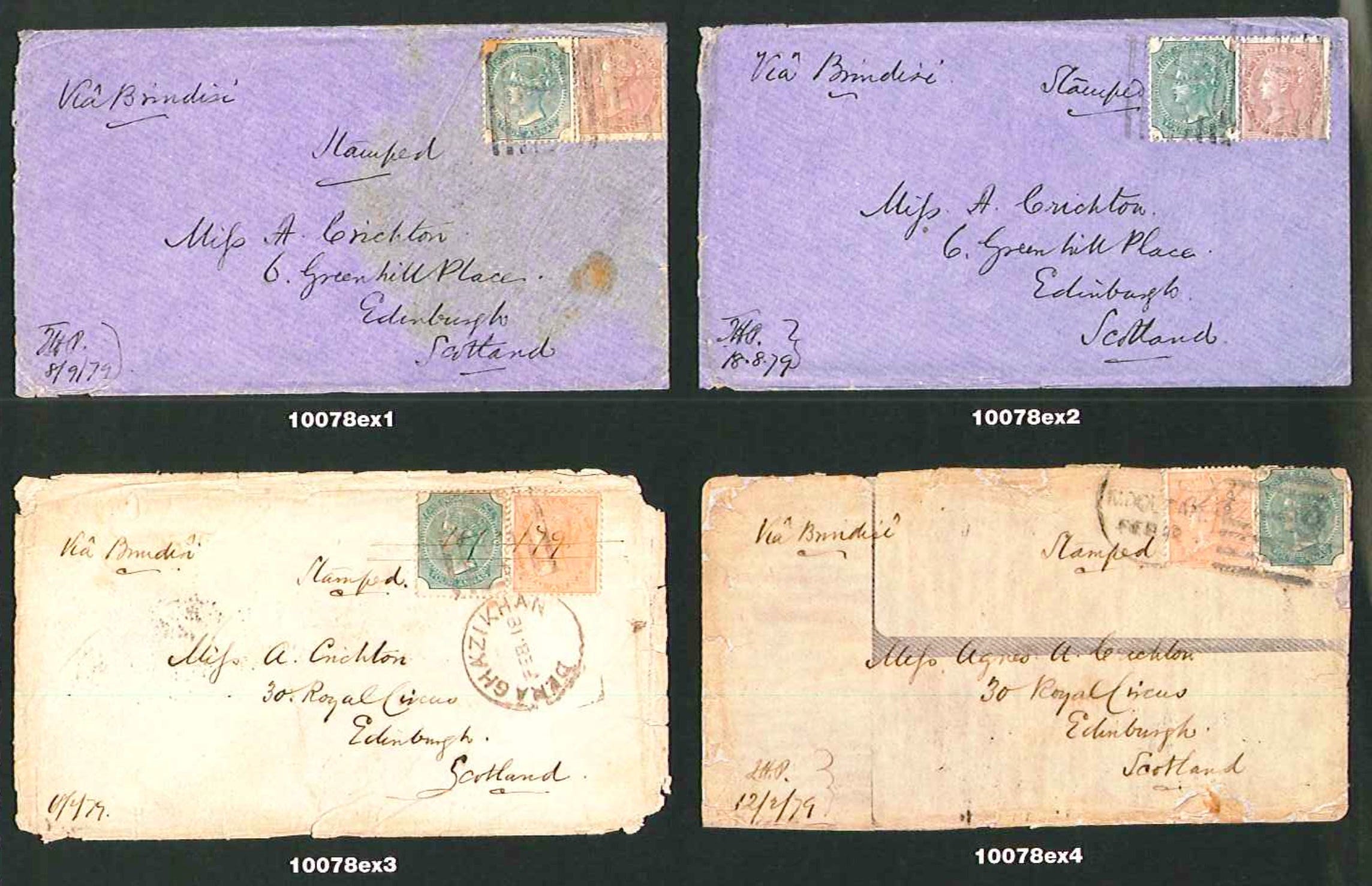
Of the five covers, one was written at Multan on 12 February 1879 (Figure 4, 10078ex3) and another at Dera Ghazi Khan on 18 February (Figure 4, 10078ex4). The two cannot be called items of ‘Second Afghan War’ postal history.
Three dated 18 August, 8 September, and 26 September 1879? (Figure 4, 10078ex2 and 10078ex1 as well as Figure N2 in the notes) bear the 8-bar square cancellation (see Figure 6) and ‘FIELD.P.O.’ cds (see Figure 7) which associates them with this war.
A New Cover Identified
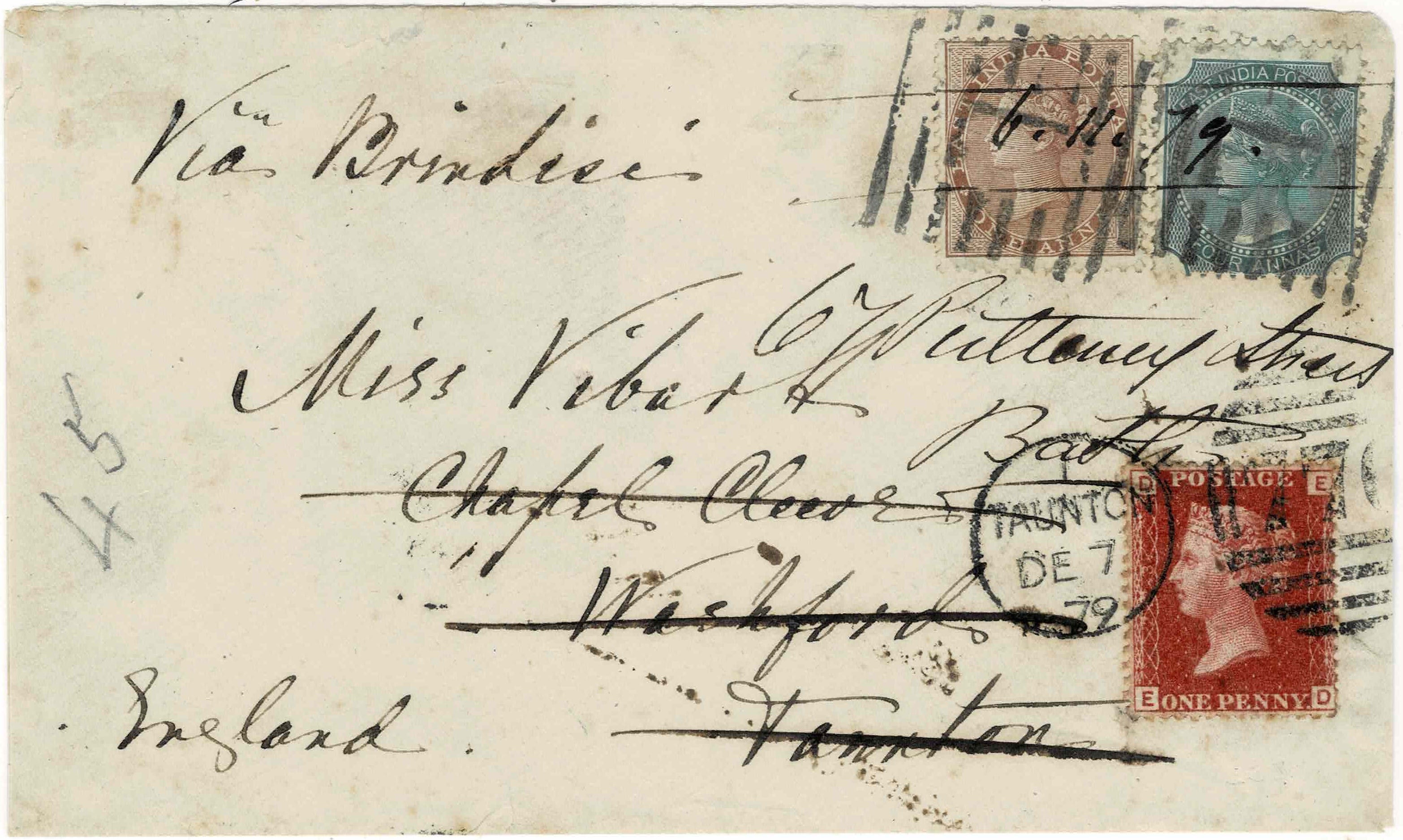
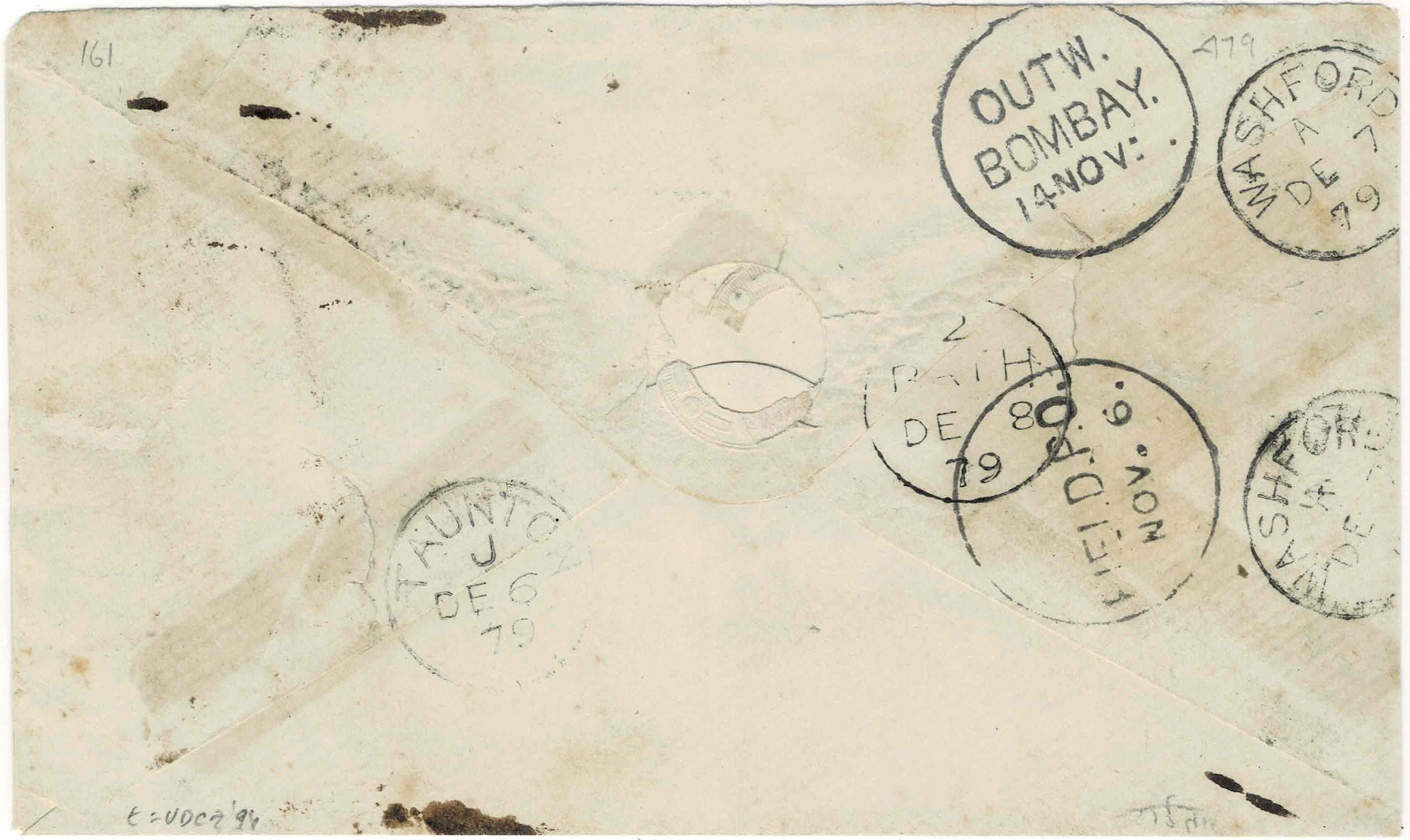
Pictured in Figure 5 is a cover from 6 November 1879 addressed to a Miss Vibart of Chapel Cleeve, a hamlet near the town of Taunton in Somerset, England.
It was franked with an 1 anna pale brown (SG58) and a 4 annas blue-green (Die II; SG72). Between 1 April 1879 and 31 January 1880 (i.e. 10 months), the postage on letters from India to Great Britain via Brindisi and weighing ½ oz was 5 annas.
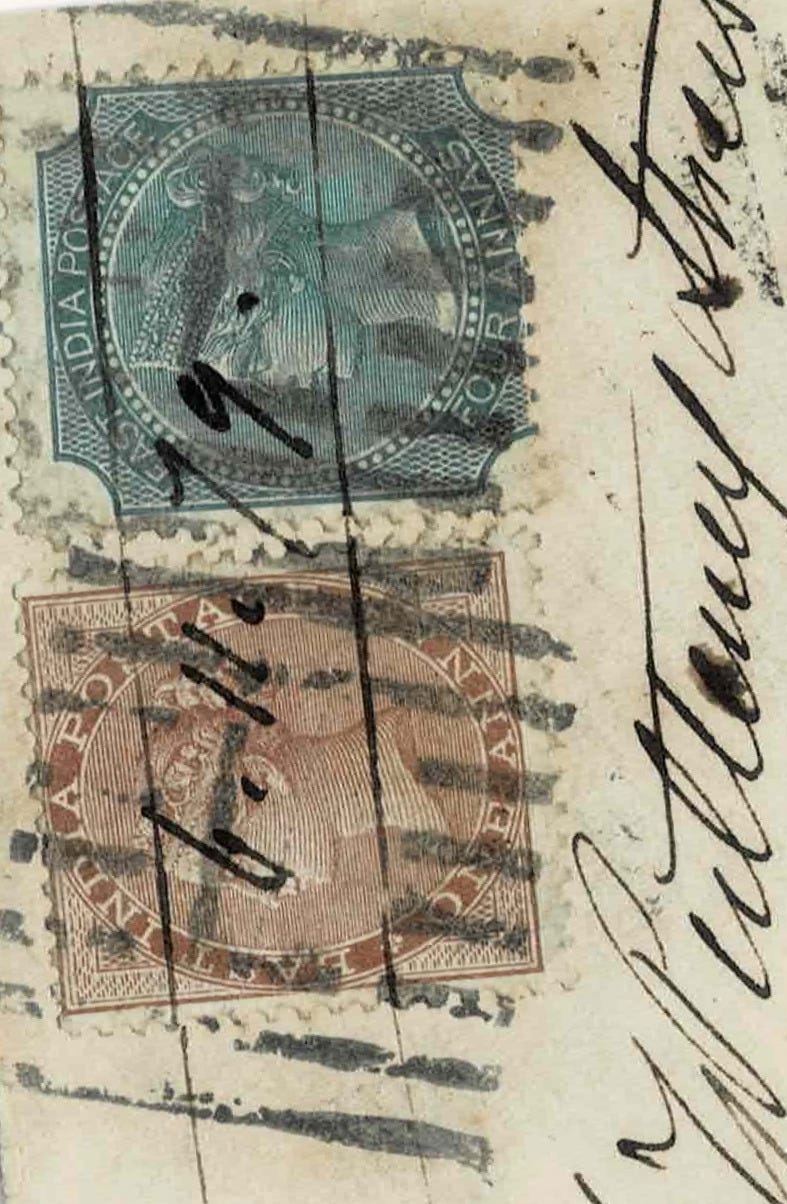
The writer initially wrote the date ‘6.11.79.’, for 6 November 1879, on the stamps. Subsequently, they were cancelled by an 8-barred square with a ‘L’ (for Lahore circle) (Figure 6).
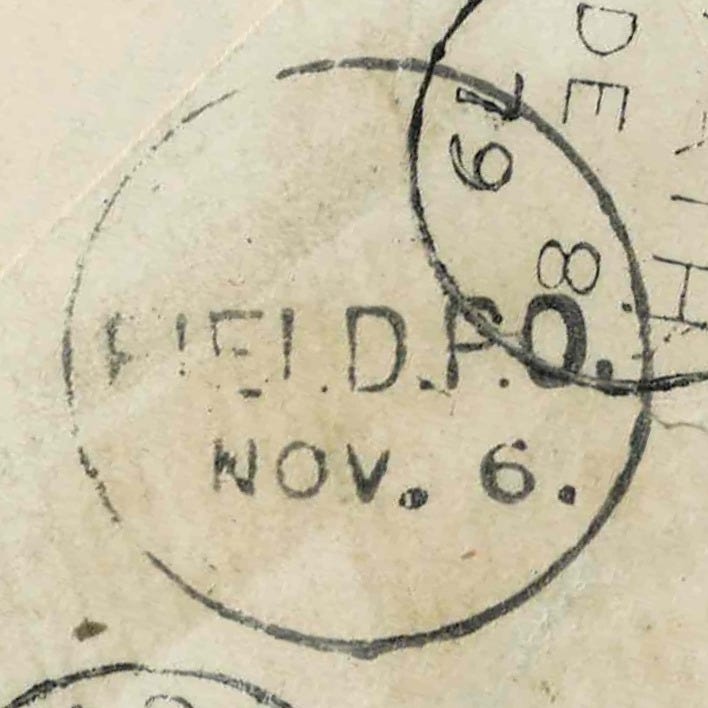
On the reverse is a black circular datestamp which reads ‘FIELD.P.O. / NOV. 6.’ (Figure 7).
An 1 penny line-engraved rose-red (plate 223; SG43) was affixed when the letter was forwarded to Bath. This stamp was cancelled by a four-bar vertical oval duplex (4VOD) of Taunton numbered 776.
Now, the ‘L’ cancellation and the ‘FIELD.P.O.’ cds are known to have been used together on letters from other places in Afghanistan too.6 I needed more information to pinpoint where exactly the letter was written from.
Identifying the Sender
The sender did not mention his name on the cover. The letter inside is, as usual, missing. So, I had only the recipient’s name and address to work with.
The prefix ‘Miss’ almost always indicates that the writer is addressing either his sister or his fiancée. If the latter, research can get difficult since she would invariably change her surname after marriage.
Anyway, in this case, I initially assumed that it was a brother writing to his sister.
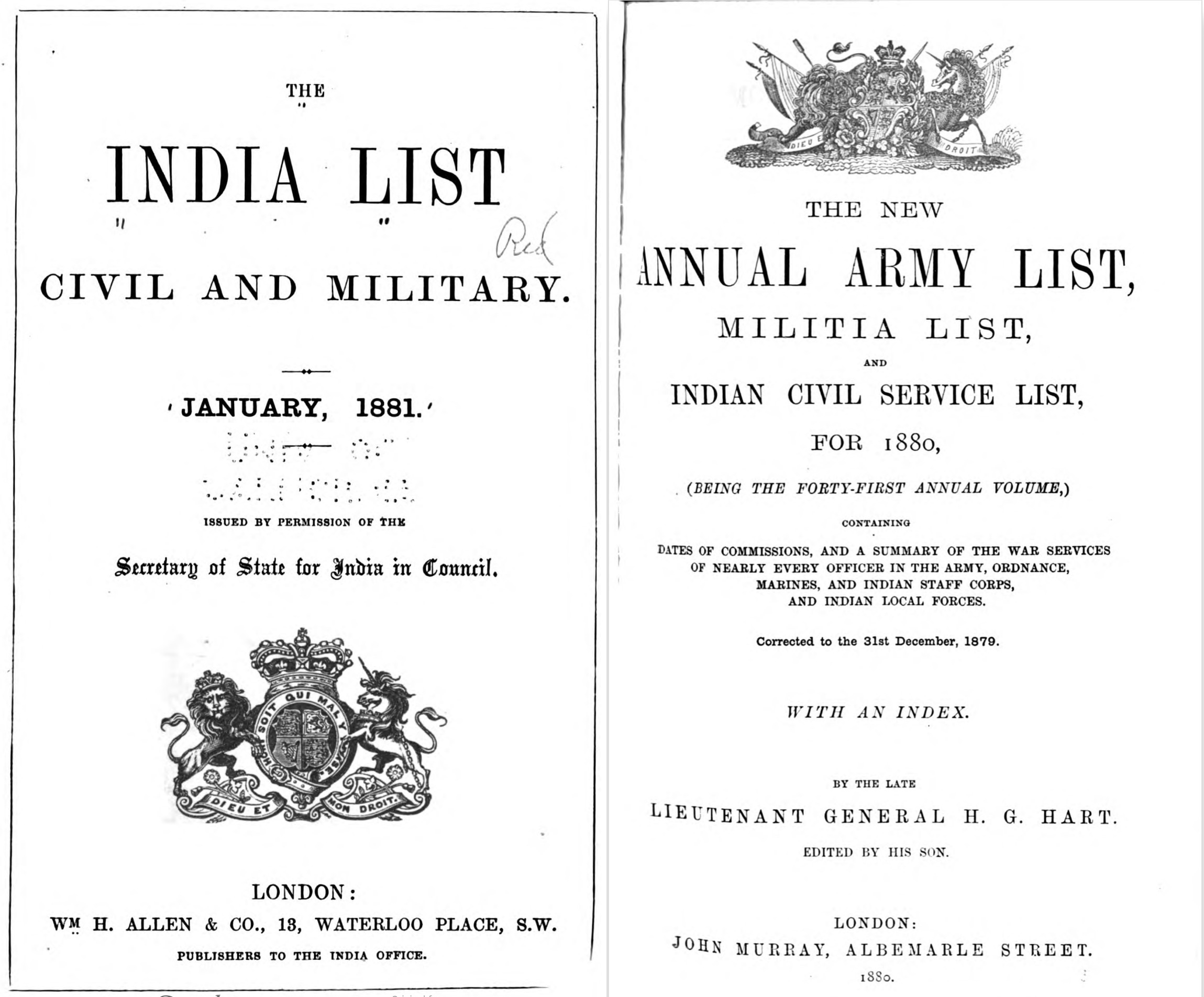
Then, I went to the closest available The India List, Civil and Military of January 1881 (Figure 8) to hunt for the brother. I found three officers with the surname ‘Vibart’. These were:
Alexander John Vibart of the 7th Bombay Native Infantry
Edward Daniel Hamilton Vibart of the 15th Bengal Native Cavalry
Henry Meredith Vibart of the Royal (erstwhile Madras) Engineers
Which Vibart was in the Afghan War?
Now, I had to find which of the three Vibarts were involved in the Afghan War.
Another publication, The New Annual Army List, Militia List, and Indian Civil Service List (popularly known as Hart’s Annual Military List) often contained additional information on Indian army regiments (unlike the India List, it also covered the British army).
The nearest that I could find was for the year 1880 which had been corrected to 31 December 1879 (Figure 8). Perfect!
According to this, Alexander (page 526) was a wing commander in the 7th, which was based in Bhooj in western India; this regiment never took part in the war.7
Henry (page 222) was an executive engineer in Trichinopoly district which is in the deep south of India.
Finally, Edward (page 433) was shown as squadron commander of the 15th. And this regiment was headquartered at Vitakri (Figure 9).
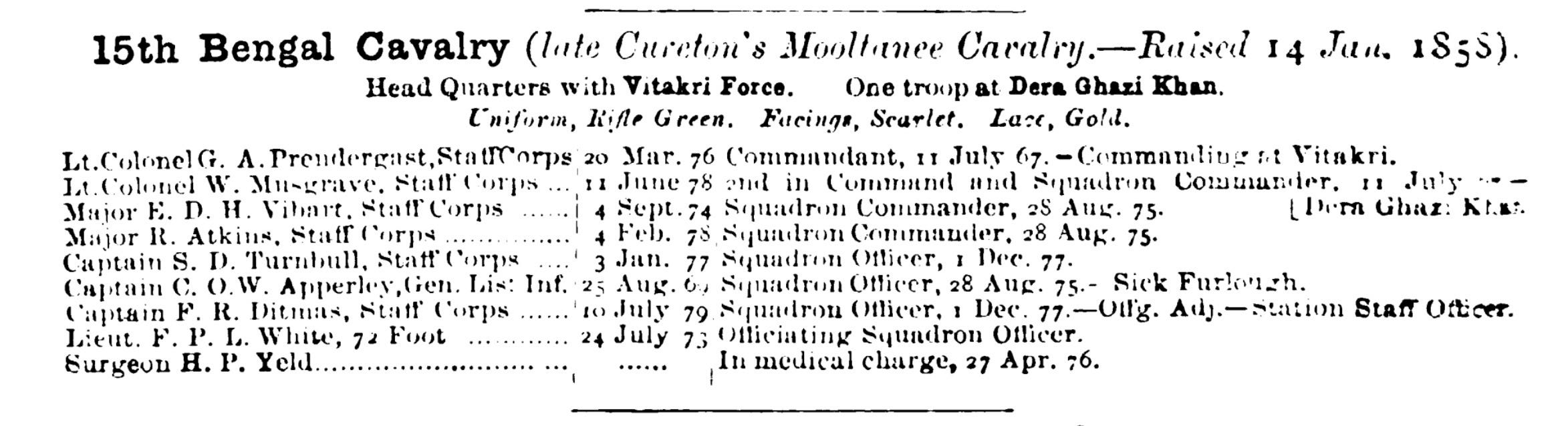
While it seemed that it was all clear, I still needed to solve one problem. Figure 8 shows the entry ‘Dera Ghazi Khan’ against Vibart’s name. Why?
More hunting led to an 1882 work on the Afghan Campaign. In it, the author says:8
In the beginning of October, 1879, in consequence of a severe outbreak of scurvy which visited the troops at Vitakri, orders were issued for all men suffering from that disease to be sent down to Dera Ghazi Khan, under the command of Col. Prendergast, instructions being at the same time given for a detachment 15th Bengal Cavalry which had been left at that station…to proceed to Vitakri to reinforce the garrison there. These instructions were carried out by the 18th, the command of the Vitakri force devolving, on that date, on Col. Georges.
Further,
Lt.-Colonel E. D. H. Vibart served with the detachment of the regiment at Dera Ghazi Khan from Feb. till Oct., 1879, commanding it from Feb. till June. Accompanied the detachment to Vitakri in Oct., 1879, and served with the Vitakri F.F. till it was broken up.
Voilà.
So, Vibart was at Dera Ghazi Khan until moving to Vitakri sometime in early-to-mid October. When he wrote his letter on 6 November 1879, he was serving with the Vitakri Field Force.
Confirming with Pope Letters
While the above left little doubt that the cover shown in Figure 5 was indeed written by someone with the Vitakri Field Force, I nevertheless decided to compare its Field Post Office obliterator and cds with that of a cover from the Pope correspondence.
A comparison of the covers in the first row of Figure 4 with Figure 5 confirms that the obliterator used is the same: the 8-bar square with a ‘L’.
Unfortunately, the description in the Dietrich catalogue does not describe the rear of these covers, which bear the cds.9
Martin Hosselmann of Germany, an advanced collector of Afghanistan, sent me Dietrich’s write-up on the Pope cover dated 18 August 1879 (Figure 10).
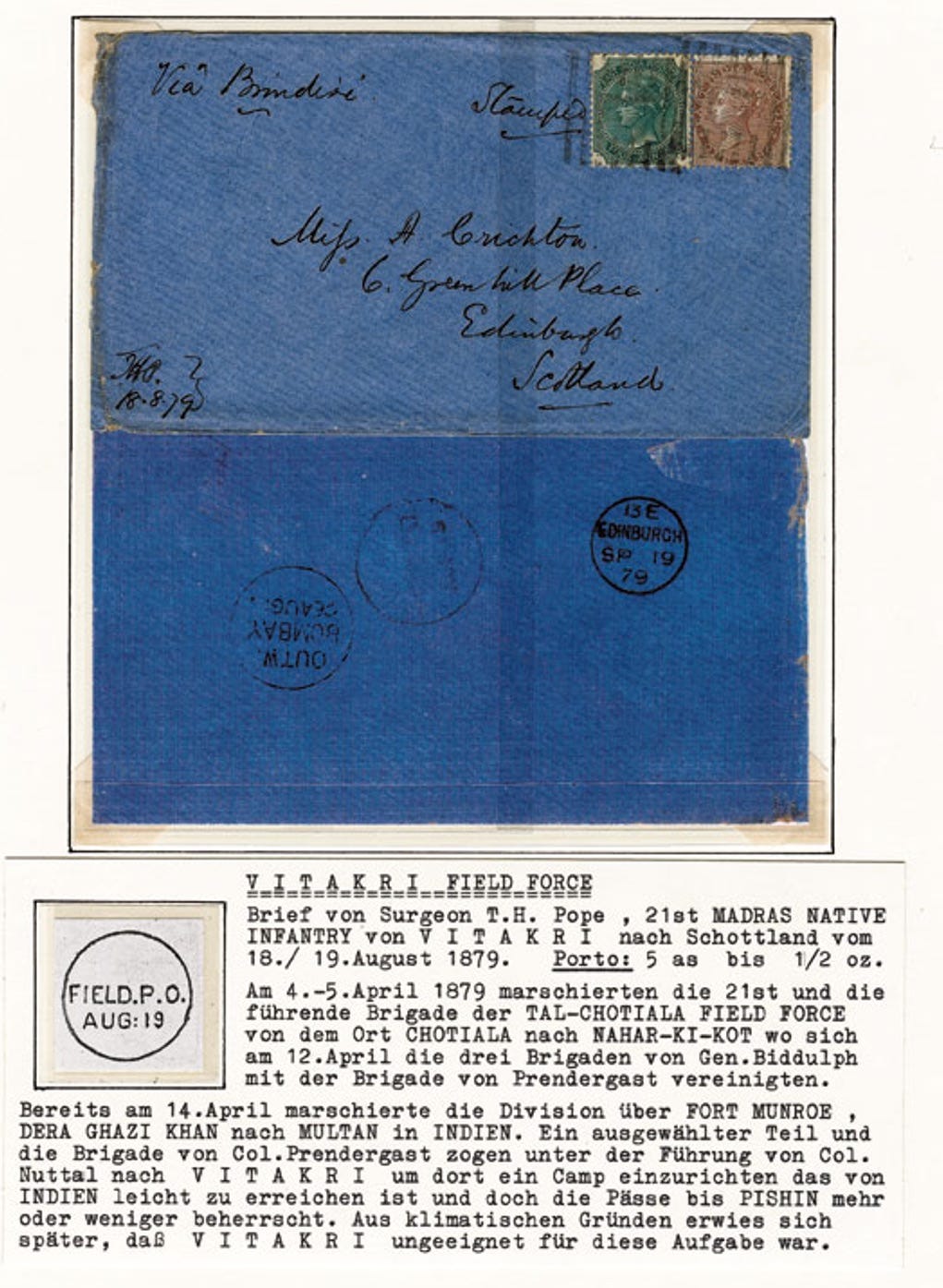
The ‘FIELD.P.O.’ on the cover is not clear but the drawing made of it by Dietrich is similar to the one on the Vibart cover.
Conclusion
Based on all the facts presented, there is no doubt that the Vibart cover is indeed a Vitakri Field Force item of postal history. The Pope correspondence can no longer be said to be ‘the only mail known from this theatre of the War.’
More on the Vibarts
Before we end, a few words on the Vibarts would be appropriate.
The writer of this letter was Major (later Colonel) Edward Daniel Hamilton Vibart (1837-1923) of the 15th Bengal Cavalry (Lancers), He joined the 54th Bengal Native Infantry as an ensign on 12 September 1854. He was promoted to lieutenant on 26 November 1856, captain on 26 August 1866, major on 4 September 1874, lieutenant-colonel on 4 September 1880, and colonel on 12 September 1884.
He fought in the Indian Mutiny of 1857-58 getting a medal with two clasps (Siege of Delhi and Lucknow). He later served in the Second Afghan War of 1878-81 and the Hazara Field Force expedition of 1888.
In 1898, his influential and revealing book The Sepoy Mutiny, as seen by a Subaltern on his experiences in the rebellion was published. This book is frequently quoted in more modern works on the mutiny.
The recipient was one of his sisters, possibly Miss Henrietta Vibart (1839?-1926), who never married.10
Their father, Major Edward Vibart (1807-1857) of the 2nd Bengal Light Cavalry, was stationed at Cawnpore when the mutiny broke out. He, his wife Emily, and four children (Emily, John, William and Louisa Mary) were subsequently killed. Three sisters (Henrietta, Georgia, and another who I am unable to identify) and Edward, who was in Delhi then, survived.
References
Afghanistan: The “Horst Dietrich” Grand Prix Collection. Geneva: David Feldman SA, 2003.
Afghanistan: The Best Classic Collection Extant. The Camellia PLC Collection. Sale No. 369. Zurich: Corinphila Auktionen AG, 2026.
Farwell, Bryon, Queen Victoria’s Little Wars. Allen Lane, 1973; reprinted, Barnsley: Pen and Sword Military, 2009.
Martin, Col. D. R. Further Postal History of the Second Afghan War 1878-81 with Kandhar and Baluchistan 1881-87: A Review in the Light of Contemporary Records. Special Series 12. The Postal History Society, 1961.
Sattin, Gerald. “Field Post Offices in and from the Kurram Valley during the Second Afghan War 1878-81.” The London Philatelist 93 whole no. 1103-04 (November-December 1984): 162-170.
Shadbolt, Sidney H. The Afghan Campaigns of 1878–80. London: Sampson Low, Marston, Searle, and Rivington, 1882.
The India List, Civil and Military, January 1881. London: Wm. H. Allen & Co., 1881.
The New Annual Army List, Militia List, and Indian Civil Service List for 1880, London: John Murray, 1880.
The Second Afghan War 1878-80, Abridged Official Account. London: John Murray, 1908.
Wilkins, John M. Afghanistan 1840-2002 Postal History Handbook. First Revised or Limited Revised 2023 edition. The Author, 2023.
Yeld, H.P. “Report on the Health of the Troops Forming the Vitakri Field Force, and upon an Outbreak of Scurvy Amongst Them.” The Indian Medical Gazette 15 no. 1 (January 1880): 10-12.
Second Afghan War, 712. This ‘little war’ cost £17.5 million of which just £5 million was borne by the British government while the balance was defrayed from Indian revenues. Yet another example of taxation without representation!
Farwell, Queen Victoria’s Little Wars, 1.
Farwell, Queen Victoria’s Little Wars, 201.
Yeld, “Outbreak of Scurvy,” 10.
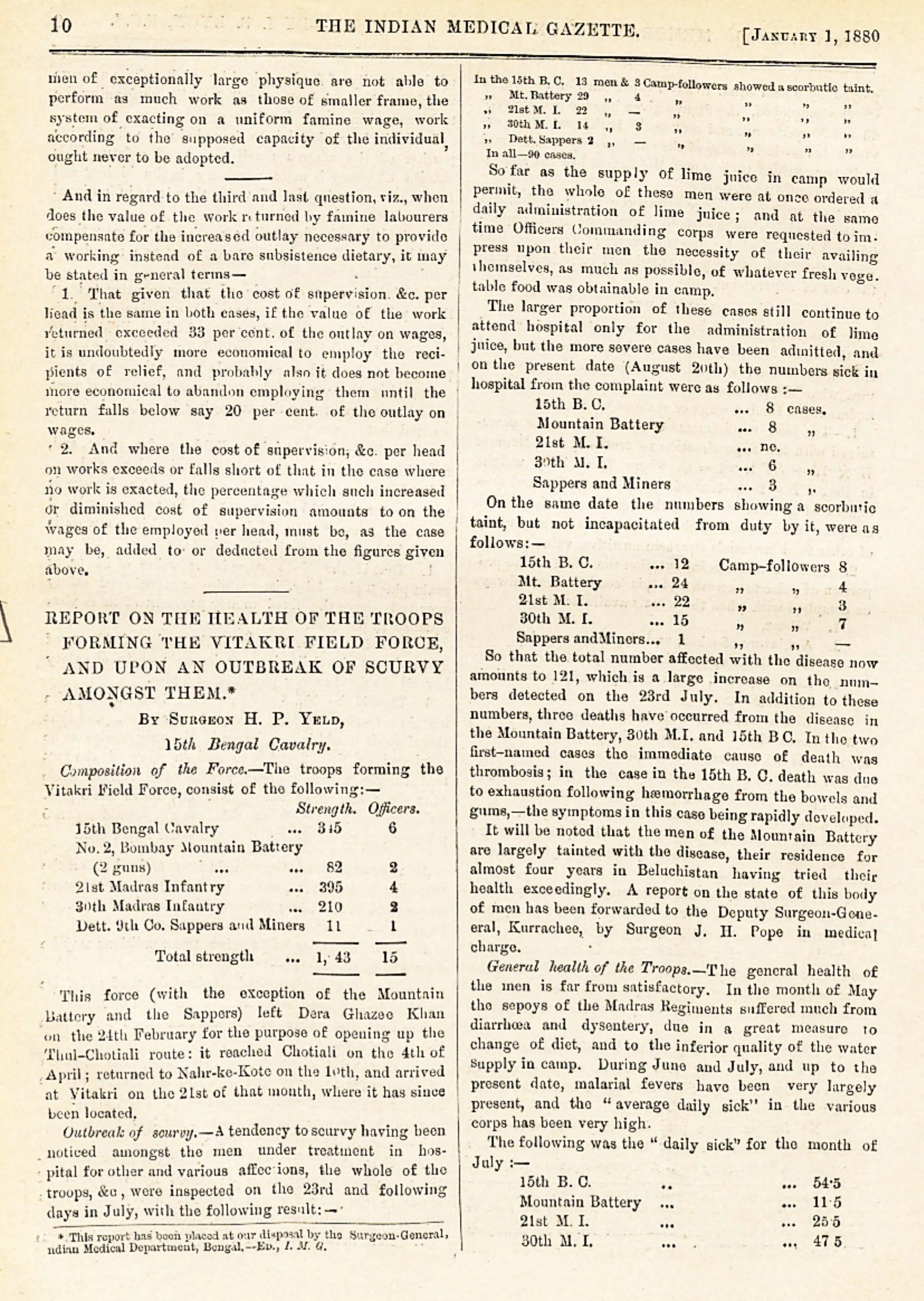
An extract of the health problems faced by the force is produced in Figure N1. The entire report is linked in the references.
Shadbolt, Afghan Campaigns, 37-38 and 263 and Second Afghan War, 652. The bulk of the military information on the Vitakri Field Force has been taken from these two books.
In his article referenced above, Sattin says:
The cds ‘FIELD. P.O.’ was also used on the Khyber route. However, it is very much rarer than that used at Kabul. The difference is found in the canceller, which is ‘L’ in a square of bars (Figure 9). So far, only two covers have been seen.
Therefore, initially I was under the impression that this was a cover from the Khyber before I arrived at the Vitakri conclusion.
Second Afghan War, 713-718. Appendix XXXIX contains an index to corps, regiments, battalions, batteries, companies, departments, etc. serving in Afghanistan between 1878 and 81. This shows that the 7th Bombay Infantry never took part in the war.
Shadbolt, Afghan Campaigns, 263.
Recently, Corinphila of Zurich auctioned the Camellia Collection of Afghanistan. Lot 10065 (Figure N2) contained three covers from the Pope correspondence. The description reads:
Vitakri Field Force 1879 (Aug 18): Cover from Sgt. Pope to Edinburgh, Scotland endorsed “via Brindisi” franked by India 1865 1 a. chocolate and 1878 4 a. blue-green tied by “L” in bars obliterator in black. Reverse with straight line “FIELD P.O. / AUG 15” despatch cds in black, Bombay transit cds (Aug 26) and Edinburgh arrival (Sept 19). Sold together with two similar covers, one somewhat toned and another with a stamp missing. Rare covers - the small Pope correspondence is the only mail known from this theatre of the War.
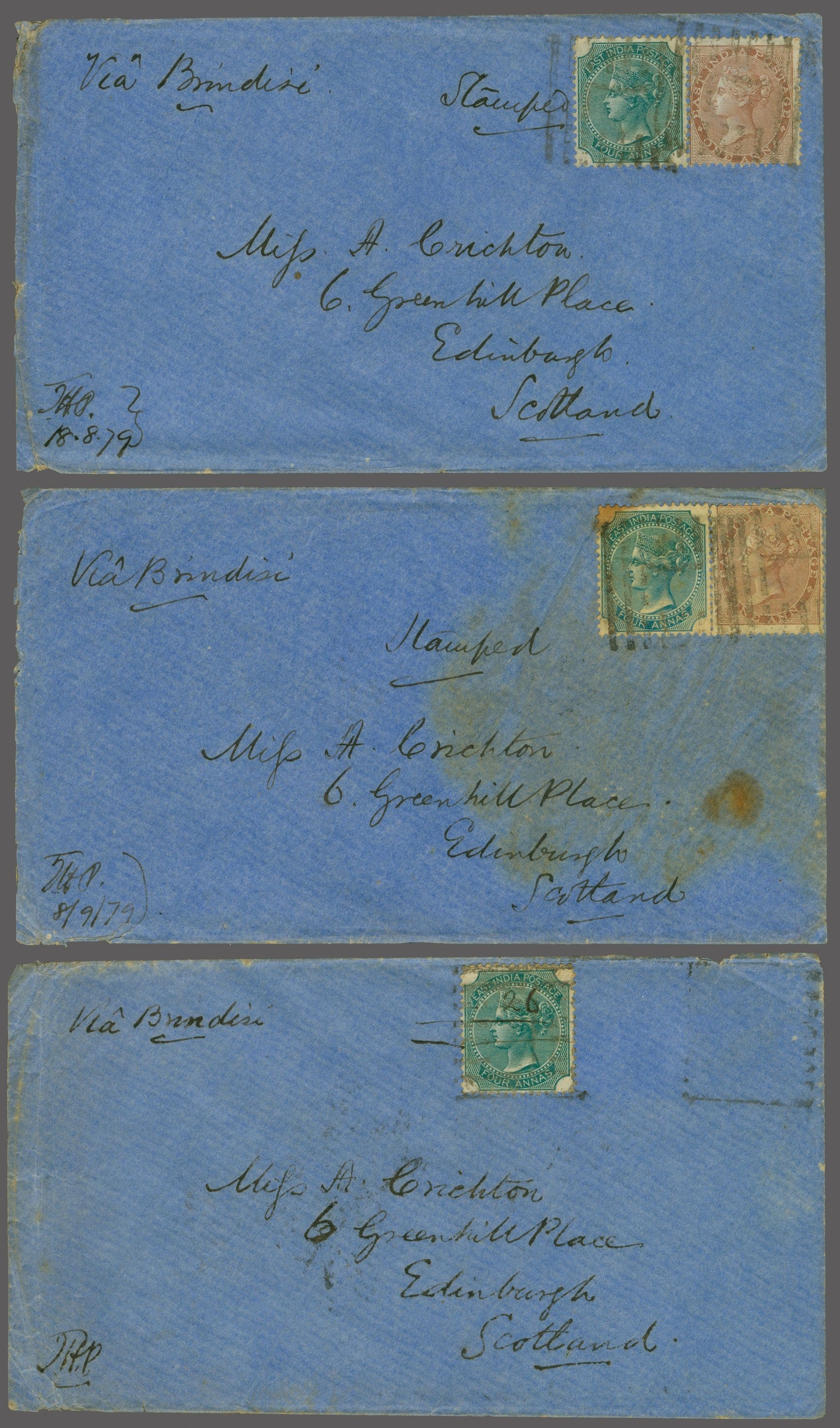
Unfortunately, here too, the rear of the covers is not pictured either in the print or online catalogue.
London Daily Chronicle, 7 October 1926, 9. The report read:
Tragic associations connected with the Indian Mutiny lay behind the death of Miss Henrietta Vibart, aged 87, who was buried at Old Cleeve, West Somerset, yesterday.
She was a daughter of Major Edward Vibart, 2nd Bengal Light Cavalry, who was stationed at Cawnpore when the outbreak occurred, and, with his wife and four children, was subsequently massacred.
Major Vibart was the last man to quit the entrenchments when the British pioneers started to walk to the banks of the Ganges, ostensibly to be sent by boats to Allahabad.
Miss Vibart, two of her sisters, and a brother, Colonel Edward Vibart, then a young subaltern stationed at Delhi, afterwards took an active part in the campaign.
Discussion about this post