Collaboration in Postal History: Case Study of a Letter from India to Great Britain and then to Sicily through the Old Italian States
By Abhishek Bhuwalka, Angelo Teruzzi, and Marco Panza
This article was co-authored with Italian postal history experts, Angelo Teruzzi and Panza Marco, and published as “La collaborazione nella storia postale: Caso di studio di una lettera dall’India alla Gran Bretagna, poi inviata in Sicilia attraverso gli Antichi Stati Italiani / Collaboration in Postal History: Case Study of a Letter from India to Great Britain then sent to Sicily through the Old Italian States” Cursores, no. 31 (May 2023). Cursores is the journal of the Associazione Italiana di Storia Postale. Members get yearly two copies of this high-class journal free. Non-members can purchase copies, including back issues, from the book store of Vaccari.
Sometime back, a postal history letter appeared in a British auction (Figure 1).1 The description read:
India Letter. 1825 (Mar 24) Entire letter from Bombay to London "pr Florentina", landed at Arundel Quay (Littlehampton), backstamped boxed "INDIA LETTER / ARUNDEL" (In.1), rated at 1/8 in Arundel, altered to 1/- in London. Readdressed to Sicily, charged 1/11, with red "ANGLETERRE" and Italian handstamps. A very rare India Letter, just three examples recorded, all on letters from this one voyage of the "Florentina", another of these illustrated by Robertson.
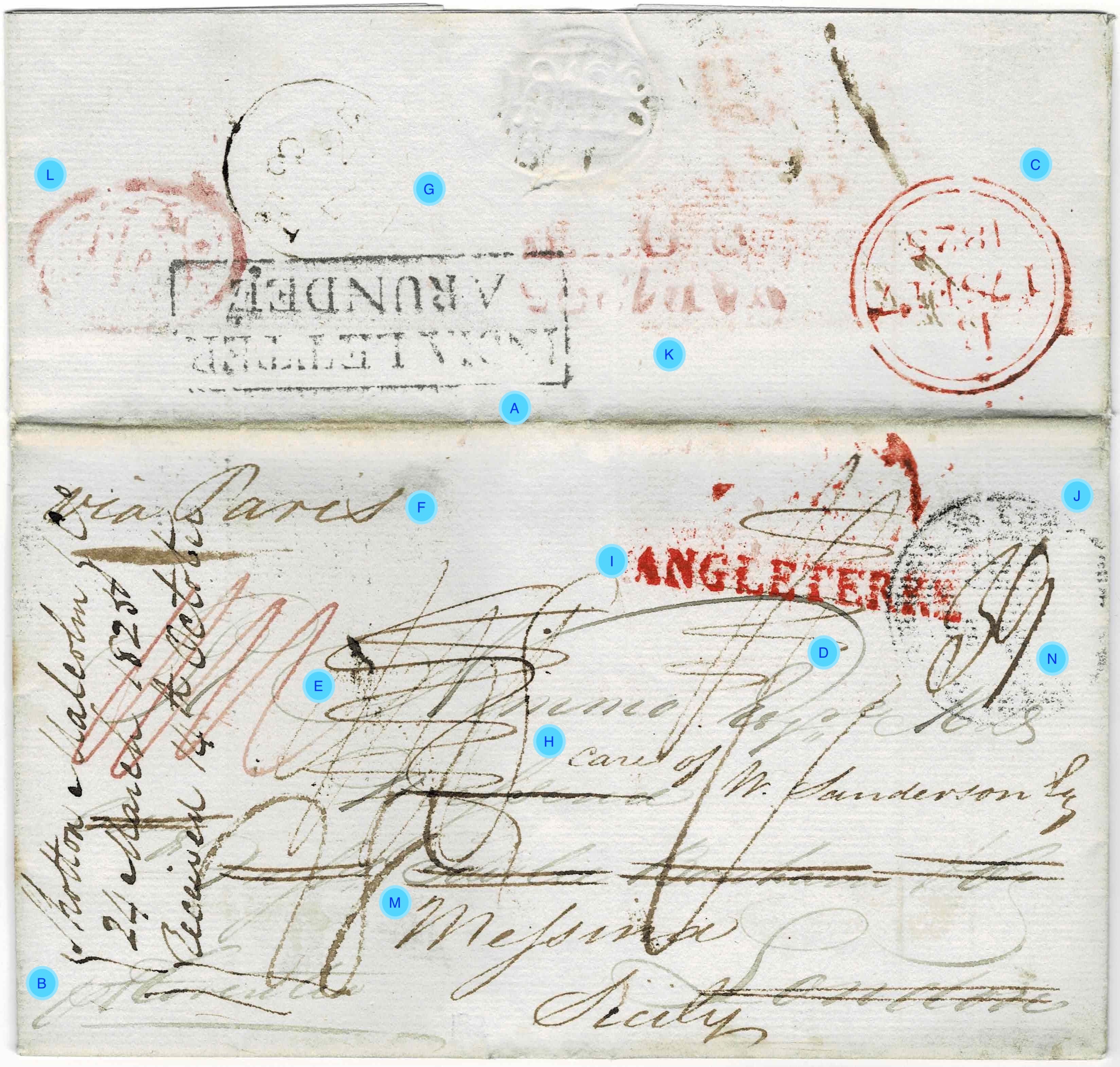
The first author knew of the ‘INDIA LETTER / ARUNDEL’ (marked ‘A’ in Figure 1) handstamp. A different letter with the same strike had appeared in a Cavendish sale of the collection of the British collector, Michael Manning, in 2015.2 That description, however, said that five examples have been recorded.

Hence, he was keen to buy this item, which he was thankfully able to (Figure 1). It was later confirmed to him that the letter was from the collection of the British postal historian, Graham Booth.3
When the author received the item, it was mounted on a page which said, among other things:
… was rated 39 annas in Bombay…and was charged 28 in local currency for the final leg to Messina.
Now, as an Indian postal history collector and researcher, he knew that the first assertion was wrong. The letter was posted from Bombay itself, a port city, and hence there was no inland postage payable. Further, Bombay Presidency4 did not levy outgoing ship letter postage from 22 April 1820 to 28 February 1831.
Hence, he approached his Italian friend, Luca Lavagnino, President of AISP, for his help in understanding the rates and markings on this cover. The latter requested Robert Abensur, Marco Panza, and Angelo Teruzzi for their inputs. An answer was finally found and is presented here. This article has been co-authored with the latter two gentlemen.
Postal Historians try to understand ‘their aspects’ of postal rules and regulations while ignoring the ‘other aspects’. This happens due to lack of knowledge arising from ignorance of or inability to find the primary and secondary sources of literature; and if found, with inaptitude in the foreign language. This article demonstrates the value of collaboration in understanding a postal history item from ‘all aspects.’
Stage 1: Bombay, India to Great Britain (GB)
Rates in India
As mentioned, there was no postage payable at Bombay and hence there are no rate markings associated with that place. Further, it was usual not to apply any Bombay postmarks on outgoing ship letters at this time.
Routing to GB
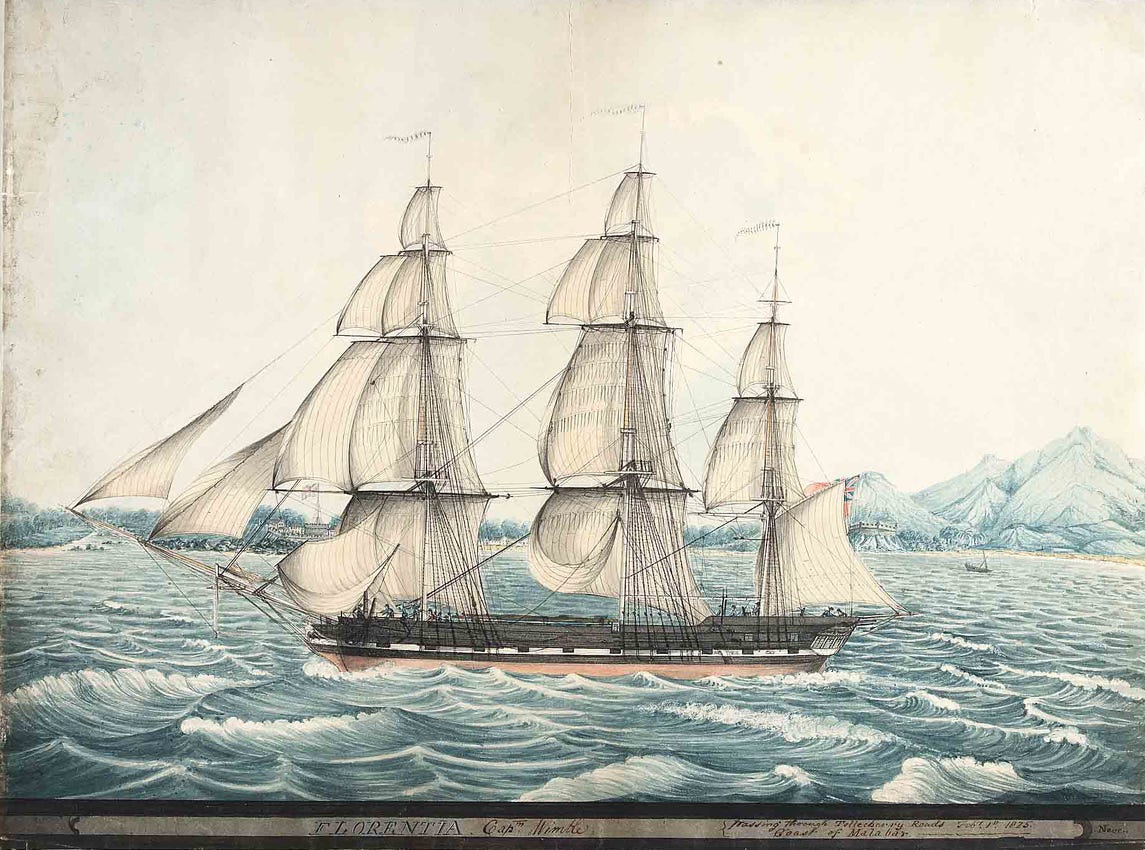
The letter was put on board the ship, Florentia (Figure 3); see routing endorsement ‘p Florentina’ by the writer (‘B’ in Figure 1). The Florentia, 452 tons, was built at Newcastle upon Tyne in 1821. This was the third of her four voyages to India for the British East India Company,5 and she was under the command of Captain John Wimble, RN. In later years she made two voyages to Australia carrying convicts.
The sailing of Florentia was as follows: Leaving Bombay on 28 March 1825, she went via Tellicherry (a port on the south-west coast of India) and St. Helena (arriving 17 July and departing 26 July) reaching Arundel sometime in mid-September (she lost her bowsprit when off the Cape on 22 June). From Arundel, she went further to Deal (16 September) and Gravesend (18 September).
As per paragraph XXI of the Postage Act, 1819 (59 Geo 3 c.111) dated 12th July 1819,6
…on the Arrival of any Ship or Vessel off the Coast of Great Britain, the Master shall cause all Letters on board his Ship (except such Letters as may be obtained by such Owners, Charterers, Consignees and Shippers as aforesaid, and except Letters and Packets exceeding the Weight of Three Ounces) to be collected and enclosed in some Bag, Box or other Envelope, to be sealed with his Seal, and to be addressed to any of His Majesty's Deputy Postmasters in Great Britain, to be in readiness to send on Shore by his own Boat or by the Pilot Boat, or any other safe and convenient Opportunity, in order that the same may be delivered at the first regular Post Office which can be communicated with…
Now, in the days of sail, ships could not always have control on where the winds would blow them to. In this case, the first port of arrival off the Coast of GB was Arundel. Letters were probably brought ashore by the ship’s boat at Arundel Quay (Robertson 1955-61, pg. E.10/B). On landing, the letter was struck with the black rectangular ‘INDIA LETTER / ARUNDEL’ recorded to have been used only in 1825 and only on letters carried by this ship on this one voyage!
Note that the ‘INDIA LETTER / {Port Name}’ handstamps were issued to most ports’ post offices to be applied on letters coming to GB from the East.7 This was because such letters were to be charged at a concessional GB incoming ship rate of 4 pence (shortened to ‘d’ hereon) per three ounces and not the otherwise usual 8d single and so on.
From Arundel, the letter made it way to London where it reached 17 September (‘C’).
Rates in GB
The letter was addressed to Mr. R. Nimmo in the care of the London forwarding agent, Fairlie & Bonham. When the agent received the letter, it paid the sums of 1s (black manuscript ‘1’ marked ‘D’; later cancelled by the forwarding agent) and 1s11d (red manuscript ‘1/11’ marked ‘E’). They also redirected the letter, via Paris (so endorsed; marked ‘F’) to the Messina forwarding agent – W. Sanderson.
What were these sums? On delivery, postage of 1s was due. Of this, 8d was the inland rate on single letters (single being defined in GB as one sheet of paper up to a weight of 1 oz) from Arundel to London (50-80 miles mileage band). From 9 July 1812 until 4 December 1839, the British inland rates were (almost) unchanged. An additional 4d can be attributed to the ‘India Letter’ rate mentioned earlier; this rate was effective 14 July 1819 to 9 January 1840.
Further, when the forwarding agent put the letter back into the post office to be forwarded to Messina, they paid 1s11d, which was the prevailing postage rate (effective 9 July 1812 to 19 July 1836) on single letters from GB to Italy paid up to the French-Sardinian border of Pont de Beauvoisin. The alphanumeric ‘F / 3 7 / 25’ (marked ‘G’; the ‘3 7’ at 90-degree angle to the rest; or is the ‘3’ an ‘8’?) (Alcock & Holland 98; Willcocks & Jay 1018a) used for outgoing mails at the London Foreign Office was then applied.
There can be seen a cancelled manuscript postage mark of ‘1/8’ (marked ‘H’), next to the ‘1/11’, for 1s8d. Based on the ink colour being the same as the 1s charge, the 1s8d is likely the inland rate later found to be wrongly calculated. An alternate (incorrect) thought may be that it was the rate to Italy via Germany and the Low Countries found to be incorrect since the letter was being routed through France; but then the ink colour should have been red and not black.
Stage 2: Great Britain to France
From London, the letter went across the English Channel to Le Havre. At that place the red handstamp ‘ANGLETERRE’ (Van der Linder 165; marked ‘I’) was applied indicating that it was a letter from England. From Le Havre, the letter went to Paris and Pont de Beauvoisin, the French-Sardinian exchange office, before entering the Kingdom of Sardinia. Remember that the letter was paid through France and hence there are no French postal markings on the letter.
Stage 3: Kingdom of Sardinia and across Grand-Duchy of Tuscany and Papal States to Naples, Kingdom of the Two Sicilies
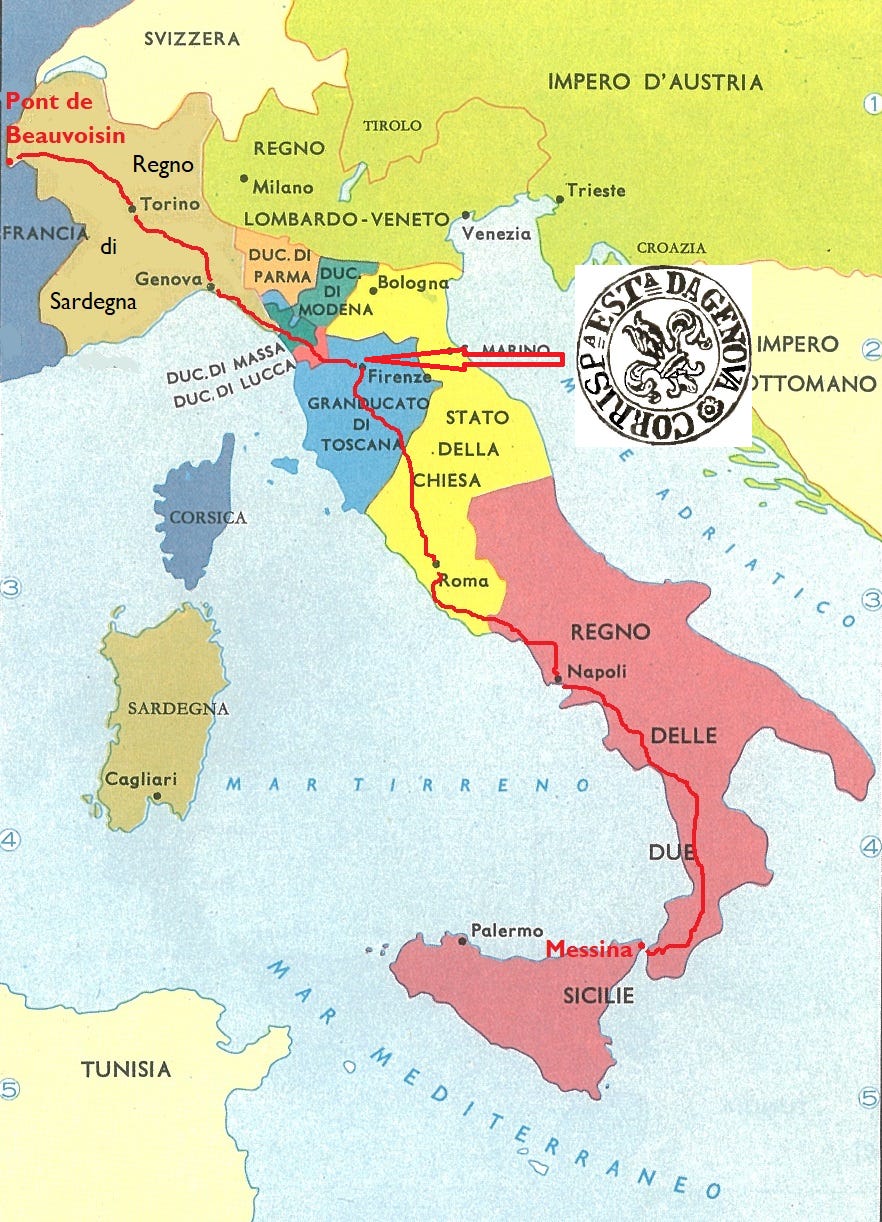
The letter was carried via Florence and Rome to Naples (Figure 4). At Florence, the letter was marked with a faint ‘CORRISPA ESTA DA GENOVA’ (for ‘Corrispondenza Estera da Genova’ or ‘Foreign Correspondence from Genoa’) (Figure 5; ‘J’). There was no postmark applied in the Kingdom of Sardinia and the Papal States, as usual.

When the letter arrived in Naples, it was struck with red two lined datestamp (the first line is ‘NAP 1825’ while the second with the day and month is indistinct) (‘K’). Also applied was the red monogram ‘AGDP’, abbreviation for ‘Amministrazione Generale delle Poste’ or ‘General Postal Administration’; this mark is usually faint and unreadable (Figure 6; ‘L’).

Before we go further, the various old Italian States’ currencies and their parities are presented below.
Sardinia: 1 Italian lira = 100 centesimi = 1 French Frank = 10 pence
Tuscany: 1 Tuscan lira (= 87 centesimi of Italian lira) = 12 crazie = 20 soldi; 1 soldo = 3 quattrini (though this currency is not discussed in this article)
Papal States: 1 Papal scudo (= 5.35 Italian lire) = 100 bajocchi
Two Sicilies: 1 Neapolitian ducato (= 4.25 Italian lire) = 100 grana
In Naples the letter was charged 28 grana (marked ‘M’) so calculated:
15 grana for the Neapolitan competence8 for a simple letter (weight equal to a quarter of ounce) coming from outside the Italian peninsula (rate according to the article 1 of the Decree n. 160 of 24 October 1815, effective 1 January 1816) plus,
Sum paid by the Grand-Duchy of Tuscany to the Kingdom of Sardinia for the transit according to the article 5 of the convention between the two countries on 9 November 1822 (14 tenths of lira for each 30 gm) plus,
Sum paid by the Papal States to the Grand-Duchy of Tuscany, according to the article 10 of the convention between the two countries of 1st July 1823 (11 bajocchi for each 30 gm).
Now we go into the details of the calculation of the competences by converting the various charges firstly into bajocchi (‘baj’) and secondly into grana.
Charge of the Kingdom of Sardinia paid by the Grand-Duchy of Tuscany: 140 centesimi (‘cents’) (=14 tenths) for each 30 grams:
1 baj = 5 cents → 140 cents = 28 baj1 baj = 1.25 grana → 28 baj = 35 grana
Charge of the Grand-Duchy of Tuscany paid by the Papal States: 11 baj for each 30 grams.
1 baj = 1.25 grana → 11 baj = 13.75 grana, rounded up to 14 grana
Total of charges of Kingdom of Sardinia and Grand-Duchy of Tuscany: 35 grana + 14 grana = 49 grana for each 30 gm
The competences of the Kingdom of Sardinia and the Grand-Duchy of Tuscany, to be refunded by the Kingdom of Two Sicilies through the Papal States, and to be paid by the recipient, for a simple letter (weight equal to a quarter of ounce) was: 1/4th of 49 grana = 12.25 grana, rounded up to 13 grana + 15 grana (competences of Naples, as previously described) = 28 grana.
Stage 4: Naples to Messina
It is necessary to specify that the Kingdom of Two Sicilies was formed in 1815 from the union of the Kingdom of Naples with the Kingdom of Sicily. The territory of the continental part down to Reggio Calabria was called Domini al di qua del Faro (literally ‘Dominions on this side of the Lighthouse’) whereas the territory of the insular part (Sicily) was called Domini al di là del Faro (‘Dominions beyond the Lighthouse’); in ancient times the Straits of Messina was called faro di Messina.
Politically and administratively, the two formed a single entity. However, the two postal administrations existing before the birth of the Kingdom of Two Sicilies were retained, one headed by Naples and the other by Palermo. Therefore, letters addressed to Sicily were subject to postal charges in Naples for the transit and those of Palermo on arrival.
The postal law of 10 November 1819, effective 1 April 1820, settled the rates that the Sicilian postal administration had to apply to letters reaching Palermo. The reference to such rates can be found in the second chapter: “Mail outside the Kingdom”, second paragraph: “Letters coming from abroad”: “Charge in favour of the postal administration of the Royal Dominions beyond the Lighthouse”. For a simple letter, the competence of Palermo was 5 grana.
The postal law also pointed out:“This rate will be added to the amount that letters and journals are charged by foreign mails and by the general administration of the Royal Dominions on this side of the Lighthouse”, namely what Naples receives as its fees. Therefore, the 5 grana pertaining to Palermo were to be summed to the 28 grana specified in Naples, which in turn was the sum of 13 grana for foreign charges and 15 grana for the Neapolitan one, as previously described. Hence 28 + 5 = 33 grana.
Such postal law added a further increase to letters addressed to Sicily. In fact: “Letters and journals coming from abroad will be additionally charged one sixth of the amount of all the postal rates”. Therefore, the amount of 33 grana, sum of all the postal rates, had to be increased by a sixth; so 33 + 1/6th of 33 = 38.5 grana, rounded up to 39 grana (black ‘39’ marked ‘N’), as reported on the cover.
References
Books
Alcock, R. C., and F. C. Holland. British Postmarks: A Short History and Guide. 2nd ed. Cheltenham: R. C. Alcock, Limited, 1977
Farrington, Anthony. Catalogue of East India Company Ships’ Journals and Logs 1600-1834. London: The British Library, 1999
Jay, Barrie. The British County Catalogue of Postal History Volume 3 - London. 2nd ed. Vol. 3. 5 vols. London: London Postal History Group, 2005
Linden, James Van der. Catalogue / Katalog Marques de Passage / Postvertragsstempel Katalog 1661-1875 (= Catalogue of Marks of Passage / Postal Stamps). Luxembourg: Soluphil, 1993
Robertson, Alan W. A History of the Ship Letters of the British Isles (An Encyclopaedia of Maritime Postal History). III vols. Pinner: The Author, 1955-61
Robinson, David. For the Port & Carriage of Letters: A Practical Guide to the Inland and Foreign Postage Rates of the British Isles 1570 to 1840. Kilmacolm, Scotland: The Author, 1990
Tabeart, Colin. Robertson Revisited: A Study of the Maritime Postal Markings of the British Isles Based on the Work of Alan W Robertson. Limassol, Cyprus: James Bendon Ltd., 1997
Post Office Documents
Decreto n. 160 del 24 Ottobre 1815 che stabilisce le tariffe da adottarsi in Napoli e nei Domini al di qua del Faro
Regal Dispaccio 13 Febbraio 1816 che stabilisce le tariffe da applicare in Sicilia
Decreto n. 1757 del 19 Dicembre 1819 relativo al servizio delle Poste al di là del Faro (Sicilia) entrato in vigore il 1° Aprile 1820
Convenzione Regno di Sardegna – Granducato di Toscana del 9 Novembre 1822
Convenzione Granducato di Toscana – Stato Pontificio entrata in vigore ufficialmente il 1° Aprile 1824
Lot 452 in Argyll Etkin’s auction of Worldwide Stamps and Postal History on 27 October 2022.
Lot 160 in Cavendish’s auction of The Micheal Manning FRPSL Collection of Indian Postal History on 9 September 2015.
Colin Graham Booth (1933-2021) was a major collector of maritime mails, especially Transatlantic, Anglo-Australian, British, and West Indies. He also collected the postal history of the Cayman Islands and many other subjects. As I write, his huge collection is being dispersed in multiple sales by different auction houses.
At this time, British India had three presidencies i.e. Calcutta, Madras, and Bombay. Prior to 1 October 1837, the post offices of the three presidencies operated differently from each other.
Farrington records only three voyages and does not mention the 1824-25 one. However, the Bombay Gazette of 26 January 1825 carried the ship’s advertisement which states ‘Was to leave England on the 2d September [1824]. Chartered by the Hon’ble Company.’ Hence this voyage has been considered as well.
Available on the superb Great Britain Philatelic Society’s (GBPS) website. See https://www.gbps.org.uk/information/sources/acts/1819-07-12_Act-59-George-III-cap-111.php. Accessed 17 February 2023.
Initially the concessional rate applied to letters from India, Ceylon, Cape of Good Hope, and Mauritius. In later years, those from Penang and Sumatra (1820), Singapore (1826), Australia (1830), Batavia (1833), Reunion & Manila (1837), and Chile, Peru, Guatemala, West Cost of America (1937) were also subject to this lower rate and struck with the INDIA LETTER stamps. The concessionary rate went away with the ‘all-in’ 8d ship letter rate effective 10 January 1840.
Part of the rate that the Naples Postal Administration retained for itself, as required by postal regulations. This amount was in addition to the amounts charged by the postal administrations of the other states.
Discussion about this post